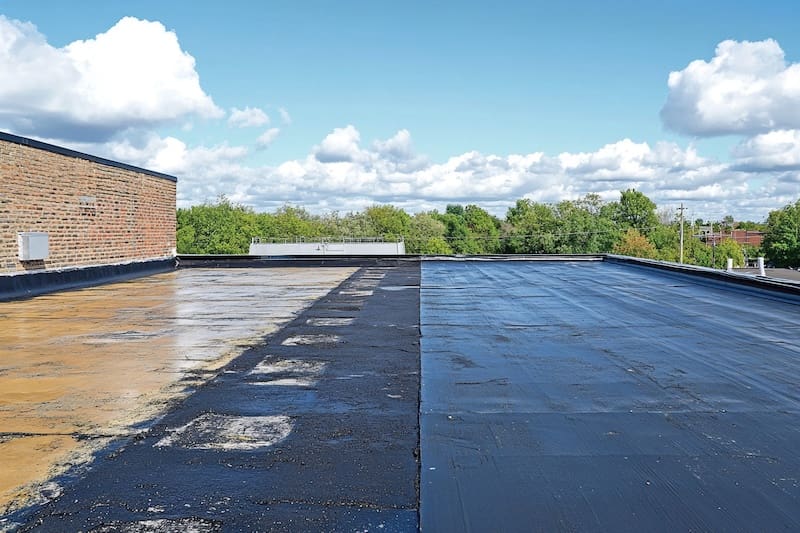

Commercial buildings in West Chester, PA, face roofing challenges throughout the year. Heavy spring rain, summer thunderstorms, and repeated freeze-thaw cycles can expose weaknesses in traditional flat roofing systems, particularly around seams and flashing. For building owners looking to reduce the risk of water infiltration, spray foam roofing offers a distinctive waterproofing solution. Unlike conventional membrane systems that rely on multiple seams and separate flashing components, spray foam roofing creates a continuous watertight surface across the entire roof.
If you’re considering spray foam roofing for your commercial property, call Oak Grove Roofing at (717) 945-9939 for spray foam roofing in West Chester, PA.
Spray Foam Roofing Eliminates Common Leak Points
Many commercial roof leaks begin where individual roofing components meet. Traditional membrane roofing systems depend on seams, laps, and flashing assemblies to keep water out. Over time, exposure to sunlight, changing temperatures, and normal building movement can cause these connections to separate or deteriorate. Once even a small opening develops, water can enter the roofing system and travel beneath the membrane before becoming visible inside the building.
Spray polyurethane foam, commonly called SPF, approaches waterproofing differently. It is applied as a liquid that expands into a rigid, closed-cell foam that conforms to the roof deck and creates one continuous surface. Because the system contains no field seams or lap joints, it eliminates many of the locations where conventional roofing systems typically develop leaks.
Another advantage is how the foam conforms to irregular roof surfaces. Instead of requiring multiple pieces of material to fit around rooftop features, the expanding foam forms a single layer that adapts to the roof’s shape. This continuous application creates a reliable barrier against water intrusion.
A Self-Flashing Waterproof System
Roof penetrations are among the most vulnerable areas on any commercial roof. Pipes, HVAC units, drains, skylights, and equipment curbs all interrupt the roof surface and require careful waterproofing. On many traditional roofing systems, these areas rely on separate flashing components that can loosen, crack, or pull away as the roof ages.
Spray foam roofing eliminates many of these vulnerable transition points through its self-flashing application. As the foam is sprayed, it expands around penetrations and adheres directly to adjoining surfaces. Rather than depending on separate flashing assemblies, the roofing system itself creates a continuous transition around these critical areas.
After the foam cures, a protective top coat is applied to the surface. This coating shields the foam from ultraviolet exposure, weathering, and direct water contact. Silicone and acrylic coatings are commonly used for this purpose, with silicone offering particularly strong performance in areas where ponding water may occur. Because the coating serves as the primary weatherproofing layer, routine inspections and timely recoating help maintain the roof’s waterproof performance for many years.
Spray Foam Roofing Performance
West Chester receives substantial rainfall throughout the year, exposing commercial roofs to heavy spring rain and powerful summer storms. These conditions place significant demands on low-slope roofing systems, especially when drainage slows or water remains on the roof after a storm.
Because spray foam roofing forms a seamless, monolithic surface, water does not encounter the lap joints or field seams found in traditional membrane systems. This eliminates potential entry points associated with field seams and lap joints. The protective top coat also serves as the roof’s first line of defense against direct water exposure while shielding the foam beneath from weather-related deterioration.
Winter presents another challenge with repeated freeze-thaw cycles. When water enters small openings in a conventional roofing system, it can freeze, expand, and gradually enlarge those gaps. Since spray foam roofing eliminates many of these vulnerable joints and flashing assemblies, it helps reduce the opportunities for this cycle to occur.
For commercial roofs that experience ponding water because of drainage limitations, silicone top coats provide an additional advantage. Silicone coatings maintain their protective properties under standing water conditions, allowing the roofing system to continue performing even after prolonged rainfall. These characteristics make spray foam roofing particularly well suited for many commercial buildings throughout West Chester.
Protect Your Commercial Building with Spray Foam Roofing
Water intrusion is a common cause of commercial roof deterioration, particularly in climates like West Chester that experience heavy rainfall and seasonal freeze-thaw conditions. Spray foam roofing addresses these challenges by creating a seamless waterproof surface, forming self-flashing transitions around rooftop penetrations, and incorporating a protective top coat that resists weather and standing water. With regular inspections and timely recoating, commercial property owners can maintain dependable waterproofing performance for many years.
For spray foam roofing in West Chester, PA, contact Oak Grove Roofing at (717) 945-9939 today.
FAQ
How does spray foam roofing help prevent leaks on a commercial roof?
Spray foam roofing creates a seamless surface with no field seams or lap joints where water commonly enters. The foam also self-flashes around pipes, HVAC equipment, and other roof penetrations, reducing common leak points. A protective top coat seals the surface against direct weather exposure.
Does spray foam roofing perform well under standing water?
Yes. Spray foam roofing finished with a silicone top coat performs well in areas where ponding water develops because silicone resists long-term exposure to standing water better than many traditional roofing materials.
What happens if the top coat on a spray foam roof becomes damaged?
Localized damage to the top coat can usually be repaired without removing the foam beneath it. Routine inspections help identify worn areas early, and recoating at the appropriate time restores the roof’s waterproof protection.